After watching the last game in the world series and seeing the Cubs win against the Cleveland Indians, I was overjoyed. I lived near Chicago for so many years that I considered them to be my home team. However, as I prepared for bed, I had a realization. Why are the Cleveland Indians the Cleveland Indians? Why should people be used as mascots? These were questions I’ve never asked myself before and didn’t have an immediate answer. But it didn’t take many Google searches before I found a pattern: Cleveland Indians, Washington Redskins, and theChicago Blackhawks. The use of human groups as mascots is evident throughout high school and professional sports teams, but this popular practice has a negative impact on the community. For this reason, Native American mascots should be removed.
Admittedly, before I read anything about Native Americans mascots, I was highly apathetic. The purpose of a mascot is to unify and represent an organization. I figured sports teams should not be judged for their mascots, but by their actions, thus a Native American mascot shouldn’t be a major problem. The Atlanta Braves, for one, fund the Atlanta Braves Foundation, an organization that gives back to the community, and the Cleveland Indians back a reward program for hardworking, inner-city students. The Chicago Blackhawks also sponsor food drives and promote child literacy rates through reading clubs and events. If these teams are judged purely by their actions, they are all laudable. I felt that those who argued for change were needlessly exaggerating. However, over time I began to realize that using human groups as mascots can be harmful to mental health.
Although the aforementioned sports teams never meant to disturb the psyche of youth, it is an unforeseen and adverse effect of doing so. When Native American youth view images with negative stereotypes of their culture, they are likely to experience symptoms of depression, heightened aggression, low self-esteem, a decreased sense of community, decreased happiness. and a higher rate of suicide. Young children and adolescents of any culture are extremely impressionable. People who are not Native Americans will continue to associate broad stereotypes/generalizations with Native American culture. Viewing these mascots distorts the perception of their culture.
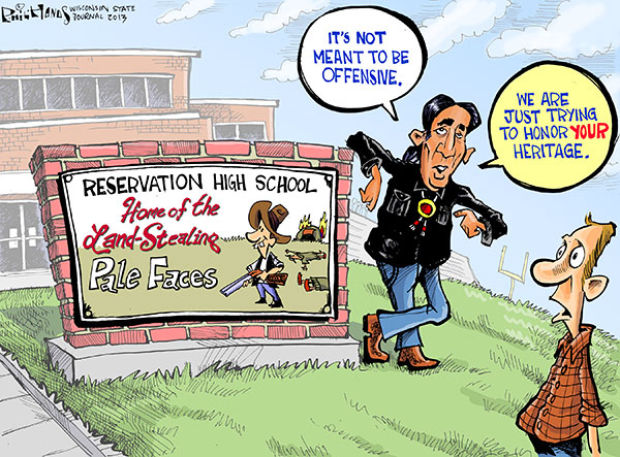
Ultimately mascots should represent an animal or non-living entity, not a human being or culture. The cartoon above flips the common argument for Native American mascots which states that being a mascot is an honor. ‘Home of the land stealing pale faces’ makes a comparison to the derogatory mascots of Native Americans. The Native American telling the white male that the mascot isn’t meant to offend represents society telling Native Americans that mascots are made in their honor. No matter the intention, mascots which portray people are offensive.
Using Native Americans as mascots denies equality and basic rights to Native American students. In 2013, Michigan passed bills which required their civil rights department to pay for the removal of Native American mascots in local high schools. The bill is changing mascots, billboards, gym resurfacing etc. If lawmakers fund the changing of mascots, schools would not have to worry about finding the required fund such an endeavor.

The National Congress of American Indians states that they have tried numerous times to remove degrading mascots of their people. The congress shows that despite most Americans not recognizing Indian mascots as problematic, they are an influential factor on the development of Native American youth and culture. An increase of violence towards Native Americans may be linked to the negative portrayal of their culture in popular media.
An example of of how an organization is attempting to correct this can be shown through the actions of Adidas. The company is providing schools funding and various designs for schools to replace their Native American mascot. Due to the many problems described above, this is a grand way to assist Native Americans and prevent some of the unfortunate effects of stereotyping.
Overall, the actions taken by Adidas and Michigan is a positive way to establish greater equality for Native Americans in school. Whether professional teams such as those mentioned above will take action to change their logo and mascot is unforeseeable; but, it is arguably an action that would improve the life of many Native American youth.
References:
 Princeton Henry