Future of the U.S

During the next administration, our country will experience various social and political changes as a result of a shift of national policy under the government. Issues such as the fate of ObamaCare , cybersecurity, reevaluation of foreign relations, and hot spots, such as North Korea internationally are some of the problems  the current administration must address.

Cyber security is a pressing issue facing America. As seen in the suspicion of cyber interference in the election and attacks in other nations, cyber vulnerabilities can lead to an increase of more sophisticated, severe attacks. This can be seen  in nations such as Ukraine where attacks have taken parts of the electric grid offline. Given  former President Obama’s increased amount of sanctions against Russia , President Trump’s reconciliatory attitude towards Russia, and future Sec. of State Tillerson’s affable relations with the country, the most optimal way to increase cyber security would be to improve the training of government personnel on cyber practices. This would lead to an improvement in  internal upgrading systems and expand Cyber Command to better identify threats and to respond if necessary.

Reform of the Affordable Care Act will be a major item which will affect a majority of Americans. President Trump and the Republican dominated Congress plan to replace/reform the ACA. Repealing the ACA would be problematic as it affects over 20 million people; without a replacement they would be without healthcare. A plan proposed by Paul Ryan would replace the ACA, though keep a few shared regulations.

Several problems have occurred which will will prevent the immediate implementation of mass deportation. Instead of mass deportation of illegal immigrants, Americans could focus on deporting extreme offenders, those who have committed violent crimes, as opposed to families, first. This would allow for both parties to reach a verdict on how to improve the immigration system.

President Trump will have a variety of foreign relations issues to contend with upon assuming office. While the U.S. abstention from UNSC 2334 upset relations with Israel, it is unlikely to be a long term issue as their government has been working with the Trump team-who advocated for a veto of the resolution. It is unclear how the peace process and a two-state solution will be affected under the new administration.

Relations with China have been called into question as Trump’s recent call with Taiwan’s president has led to concerns on the adherence to the one China policy. China has expressed their lack of interest working with the US if they choose to acknowledge Taiwan as a separate country. Additionally, the balance of trade between China and the U.S. could change under the new Administration. Upon assumption of office, President Trump will have a host of foreign and domestic issues to contend with. From reevaluating our foreign policy, protecting the nation in cyberspace, sorting out domestic issues such as immigration that are a source of contention, this administration will lead the country on a new path.

Warping Native American Culture

After watching the last game in the world series and seeing the Cubs win against the Cleveland Indians, I was overjoyed. I lived near Chicago for so many years that I considered them to be my home team. However, as I prepared for bed, I had a realization. Why are the Cleveland Indians the Cleveland Indians? Why should people be used as mascots? These were questions I’ve never asked myself before and didn’t have an immediate answer. But it didn’t take many Google searches before I found a pattern: Cleveland Indians, Washington Redskins, and theChicago Blackhawks. The use of human groups as mascots is evident throughout high school and professional sports teams, but this popular practice has a negative impact on the community. For this reason, Native American mascots should be removed.
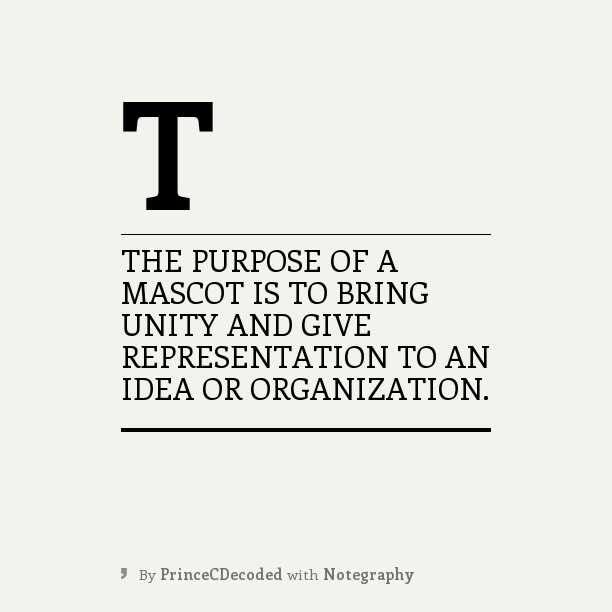
Admittedly, before I read anything about Native Americans mascots, I was highly apathetic. The purpose of a mascot is to unify and represent an organization. I figured sports teams should not be judged for their mascots, but by their actions, thus a Native American mascot shouldn’t be a major problem. The Atlanta Braves, for one, fund the Atlanta Braves Foundation, an organization that gives back to the community, and the Cleveland Indians back a reward program for hardworking, inner-city students. The Chicago Blackhawks also sponsor food drives and promote child literacy rates through reading clubs and events. If these teams are judged purely by their actions, they are all laudable. I felt that those who argued for change were needlessly exaggerating. However, over time I began to realize that using human groups as mascots can be harmful to mental health.

Although the aforementioned sports teams never meant to disturb the psyche of youth, it is an unforeseen and adverse effect of doing so. When Native American youth view images with negative stereotypes of their culture, they are likely to experience symptoms of depression, heightened aggression, low self-esteem, a decreased sense of community, decreased happiness. and a higher rate of suicide. Young children and adolescents of any culture are extremely impressionable. People who are not Native Americans will continue to associate broad stereotypes/generalizations with Native American culture. Viewing these mascots distorts the perception of their culture.
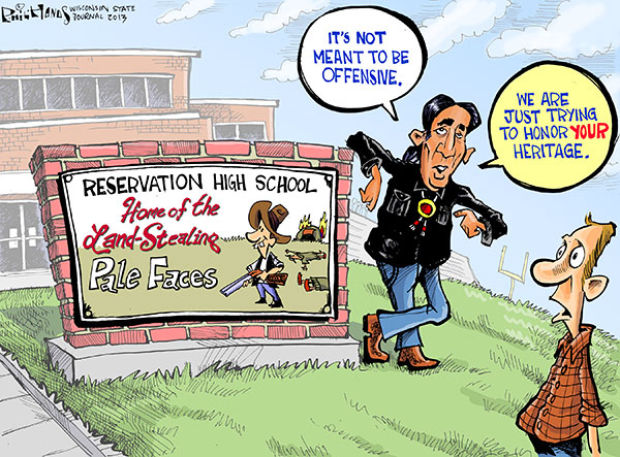
(Hands Phill 2013.  23 September 2016)

Ultimately mascots should represent an animal or non-living entity, not a human being or culture. The cartoon above flips the common argument for Native American mascots which states that being a mascot is an honor. ‘Home of the land stealing pale faces’ makes a comparison to the derogatory mascots of Native Americans. The Native American telling the white male that the mascot isn’t meant to offend represents society telling Native Americans that mascots are made in their honor. No matter the intention, mascots which portray people are offensive.

Using Native Americans as mascots denies equality and basic rights to Native American students. In 2013, Michigan passed bills which required their civil rights department to pay for the removal of Native American mascots in local high schools. The bill is changing mascots, billboards, gym resurfacing etc. If lawmakers fund the changing of mascots, schools would not have to worry about finding the required fund such an endeavor.

The National Congress of American Indians states that they have tried numerous times to remove degrading mascots of their people. The congress shows that despite most Americans not recognizing Indian mascots as problematic, they are an influential factor on the development of Native American youth and culture. An increase of violence towards Native Americans may be linked to the negative portrayal of their culture in popular media.

An example of of how an organization is attempting to correct this can be shown through the actions of Adidas. The company is providing schools funding and various designs for schools to replace their Native American mascot. Due to the many problems described above, this is a grand way to assist Native Americans and prevent some of the unfortunate effects of stereotyping.

Overall, the actions taken by Adidas and Michigan is a positive way to establish greater equality for Native Americans in school. Whether professional teams such as those mentioned above will take action to change their logo and mascot is unforeseeable; but, it is arguably an action that would improve the life of many Native American youth.

References:

CBS Controversial Mascots

NPR What’s In A Name

AP Adidas Offers Help to Eliminate Native American Mascots

Atlanta Brave Foundation

Cleveland Indians

National Congress of American Indians
Warfare Has a New Face

Children have been heavily relied upon in history. In hunter-gatherer societies, children were used as laborers once they reached an age where they could walk. During the 1700’s, children were primarily seen as an extra set of hands to work the fields, while in the industrial revolution, children worked in factories and mills in harsh conditions that were unfit for modern society. Now, children are seen as an extra pair of hands to hold a gun. Although the use of children as soldiers may be seen as an effective way to fight, spy, and remove a child from a potentially negative life at home, the use of children as soldiers drastically harms their physical and psychological state. Many organizations and countries have acted to reduce the amount of children used as soldiers; however, education and awareness are the best solutions to reduce the amount of child soldiers.

Conflicts from 1946-2012

History of Children Soldiers

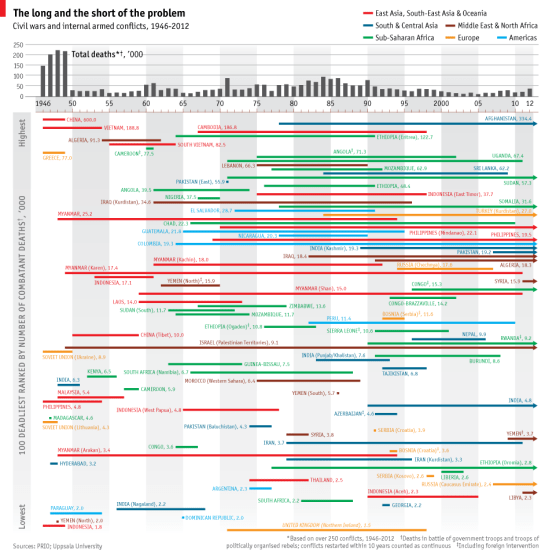
During the 1990’s several wars and armed conflicts occurred in which children were used to fight against factions or the government. The infographic includes the many casualties from the the Rwandan civil war and the following genocide where the Hutu majority of the Democratic Republic of Congo killed the Tutsi minority. The UN estimated that approximately 15-30% of people recruited to engage in the genocide against the Tutsis were minors. The use of child soldiers is not a new practice, during the Ottoman Empire young Christian and Jewish boys (Janissary Corp) were the prized fighting force of the Turkish country. Later, when the Soviet Union invaded Afghanistan in 1997, approximately 300,000 children were killed due to being soldiers. The use of child soldiers is not limited to one country or region of the world. During World War II, Great Britain and Germany used children and young teenagers to fight the opposing side. Great Britain’s Home Guard was formed of young teenagers. The teenagers would have been considered child soldiers as they were below the age of 18 and required to serve in army. The use of children was more evident in Germany as the Hitler Youth were indoctrinated from childhood. They were later trained to become soldiers. The differences in gender often determined what job was required, which determined the effect of war on the children. Young girls were often used as porters or sex slaves, which resulted in psychological trauma/post traumatic stress disorder and a higher risk for drug abuse. Young boys who were typically used as soldiers and spies experienced trauma that were similar to girls. Boys suffered from post traumatic stress disorder, had a higher change for drug abuse later in life, and had a reduced change to form functional relationships in adulthood. While the psychological traumas often drastically impair the life of those involved, the physical effects shown highlight the gruesome reality of children involved in warfare.

Effects of Warfare on Children

The loss of limbs, deafness, blindness, and a reduced quality of life after being harmed, are all results of children being exposed to war young. Organizations and countries have attempted to reduce the negative effects of war on children. But, attempts to prevent children soldiers are still fairly recent as until 1949 with the addition of article 77.2 to the geneva conventions, children soldiers were still acceptable and thus, common. Several organizations/countries are collaborating to reduce the effects of child soldiers.

Current Solutions

Countries have attempted to reduce the amount of child soldiers by signing treaties and collaborating to reach a solution. Many organizations are trying to bring awareness to child soldiers through educating the public such as ‘Children and Armed Conflict’ and ‘Child Soldiers International Documents’. UNICEF has been a major advocate for the reduction/eradication of children soldiers. UNICEF has tried to reduce the amount of landmines by increasing awareness and creating an International Day for Mine Awareness and Assistance in Mine Action. Unfortunately, children make better soldiers as they are obedient and easily manipulated.

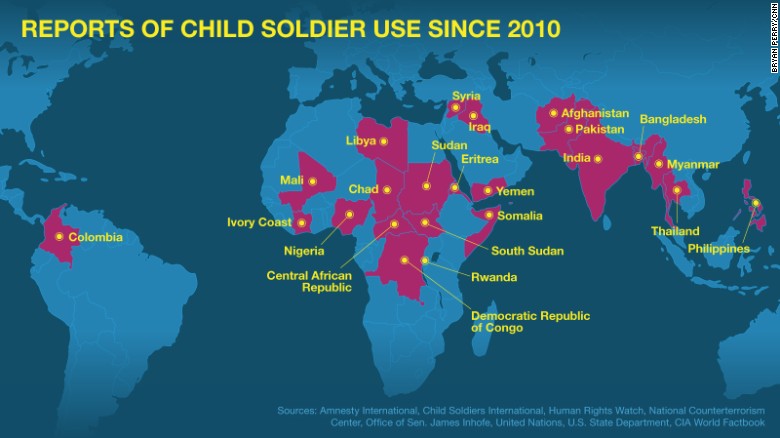
The UN is also a major actor in the attempted reduction of child soldiers, 55 countries are preventing minors from becoming soldiers by criminalizing the act of using minors as soldiers. Countries such as South Sudan and Yemen, which still have problems with the use of child soldiers, are working with the UN to prohibit minors from being involved in war. Armed conflicts and tension among countries have increased in the past few decades as shown through the previously mentioned Rwandan civil war, recruitment of children by ISIS, and recruitment by Boko Haram.

Child Soldiers Worldwide

Potential solutions

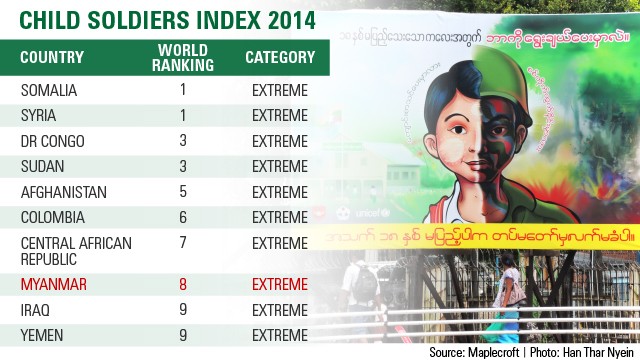
The only way to permanently eradicate the use of child soldiers would be to completely eliminate conflict worldwide. Given this unrealistic goal, better actions would be to increase education available to regions that lack access. Poorer regions that lack access to education are among the first areas which children volunteer to be soldiers. The first places money for education should be sent is South Sudan, Nigeria, Somalia, and the Democratic Republic of Congo as these are some of the areas which children soldier rates are the highest. If education rates are increased, children and parents would learn that being a soldier is not the only option available to improve their lives. Education funded by organizations monitored by UNICEF and the UN would help ameliorate the problems caused by child soldiers.

References:

Effects of War on Children

Rwandan Genocide

Advocates for Human Rights